Claim
State the property being tested without silently expanding it into a broader assurance claim.
BPM RED Academy separates capability claims, operational authority and validation evidence. Confidence is earned through defined boundaries, repeatable tests, preserved artifacts and accountable review.
A model score or successful demo does not establish operational trust. The evidence package must identify what was tested, under which conditions, what failed, and who accepted the result.
State the property being tested without silently expanding it into a broader assurance claim.
Define authority, policy, environment, inputs, tools, infrastructure and stop conditions.
Preserve outputs, provenance, telemetry, exceptions, reviewer actions and acceptance records.
These labels describe evidence maturity. They are not marketing grades, and they should not be interpreted beyond the stated test scope.
The claim, test design or acceptance gate exists, but no execution evidence is being asserted.
Evidence exists from exploratory or bounded runs, but operational acceptance is not being claimed.
The behaviour has been observed under stated conditions with artifacts sufficient for technical review.
A specific claim has passed a defined validation contract. The scope and limitations remain part of the claim.
Assurance work follows a controlled sequence so failure is visible rather than averaged away.
What exactly must remain true?
Authority, policy, data, models, tools and infrastructure.
Run the workflow while preserving provenance and runtime evidence.
Repeatability, variants, contradictory inputs and adversarial conditions.
Where relevant, test whether governance properties survive infrastructure changes.
Human review closes the validation contract and records limitations.
Public material can describe methods, claims and selected results without publishing customer data, credentials, proprietary orchestration logic, private thresholds or security-sensitive deployment details.
The objective is not to make every system perfectly predictable. It is to make authority bounded, execution observable and failure reviewable.
BPM-RN-001 publishes the current runtime baseline and explicitly keeps the independent cross-infrastructure repeat in the planned state.
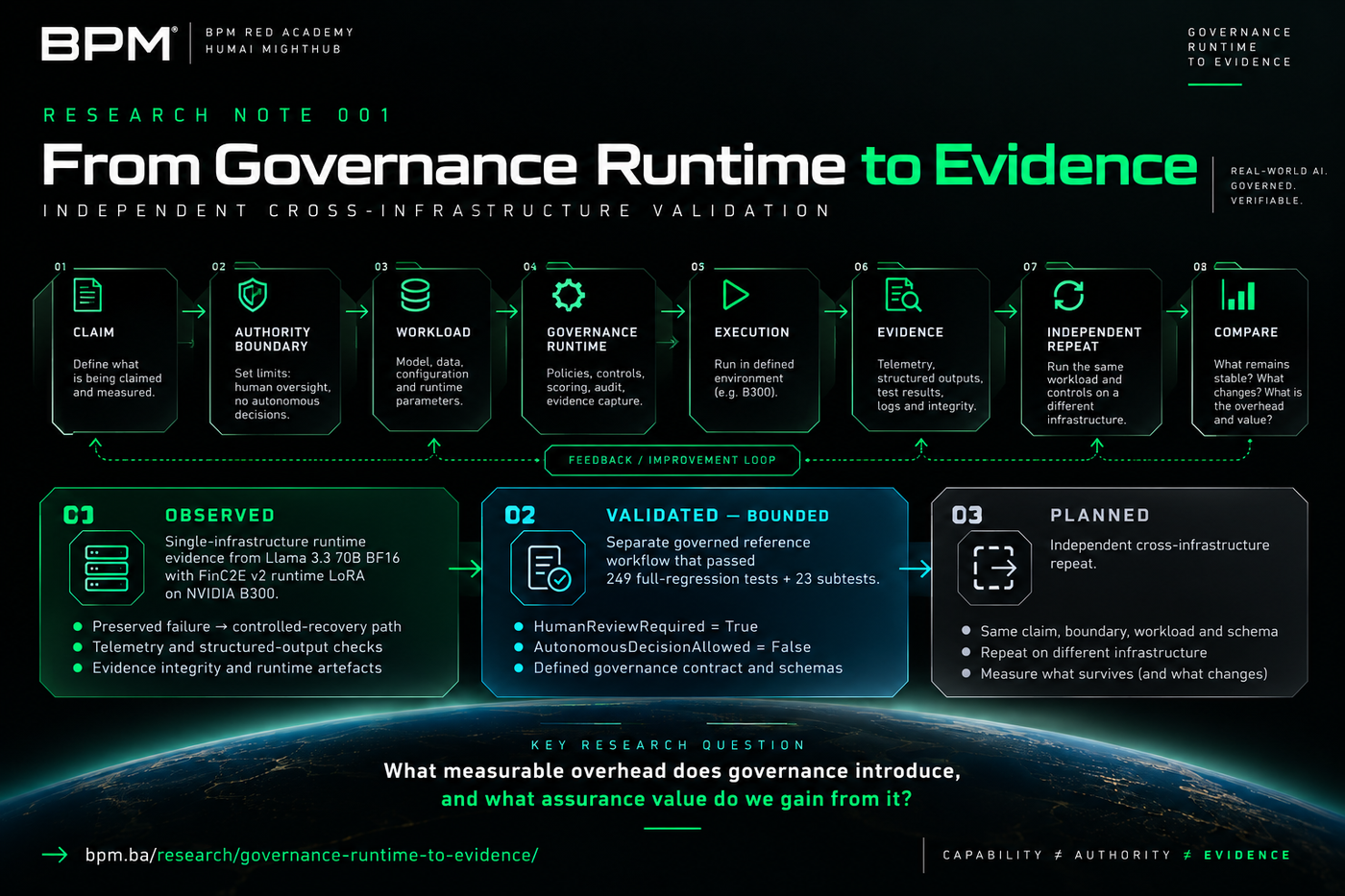
B300 runtime evidence, bounded workflow validation, limitations and the next independent portability test.
Qualified reviewers can request a controlled technical brief or discuss a scoped validation engagement.