Integrity
Does the system preserve intended policy, workflow and data-handling boundaries under normal execution?
We treat assurance as an engineering discipline: define the claim, test the boundary, preserve the artifacts and make failures visible.
Claims are defined, boundaries tested, runs repeated and evidence preserved before acceptance.
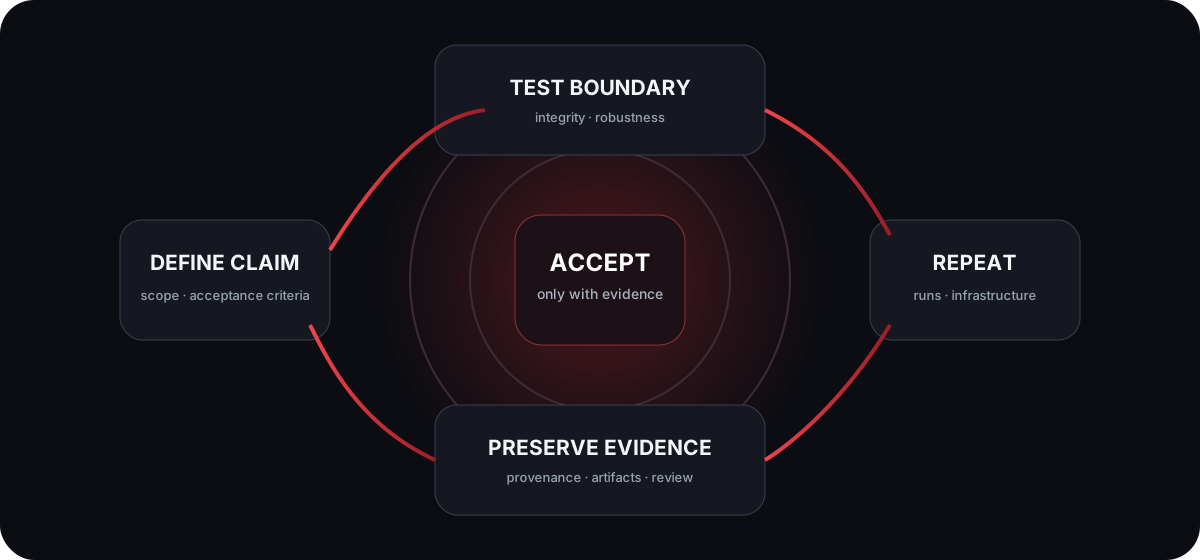
Runtime confidence should come from reproducible validation rather than from model reputation or benchmark scores alone.
Does the system preserve intended policy, workflow and data-handling boundaries under normal execution?
Can equivalent conditions produce stable, explainable behaviour and evidence across repeated runs?
How does the system respond to contradictory, incomplete, adversarial or out-of-policy inputs?
Can material outputs be traced back to their source inputs, transformations and decision path?
Do governance and runtime properties remain consistent when the workload moves across compute environments?
Are logs, reports, test results and acceptance artifacts sufficient for independent technical and governance review?
We prefer measurable gates, source-controlled tests and reproducible artifacts over broad claims of safety, trust or compliance.
HMH-GRA completed its defined cross-infrastructure technical validation scope with a closed evidence chain. This is a project result within stated boundaries; it does not establish cross-infrastructure governance reproduction, normalized performance comparability or exhaustive fault tolerance.
The detailed Governance Runtime Assurance page separates test families, authority boundaries, evidence status and limitations.
Agree the claim, boundary and acceptance question before a separately scoped validation sprint.