Integrity
Does policy, workflow and authority behave as intended under normal operation?
Claim-based assurance for testing whether governance properties remain observable, repeatable and reviewable when AI systems actually execute.
HMH-GRA completed its defined cross-infrastructure technical validation scope with a closed evidence chain. This is a project result within stated boundaries; it does not establish cross-infrastructure governance reproduction, normalized performance comparability or exhaustive fault tolerance.
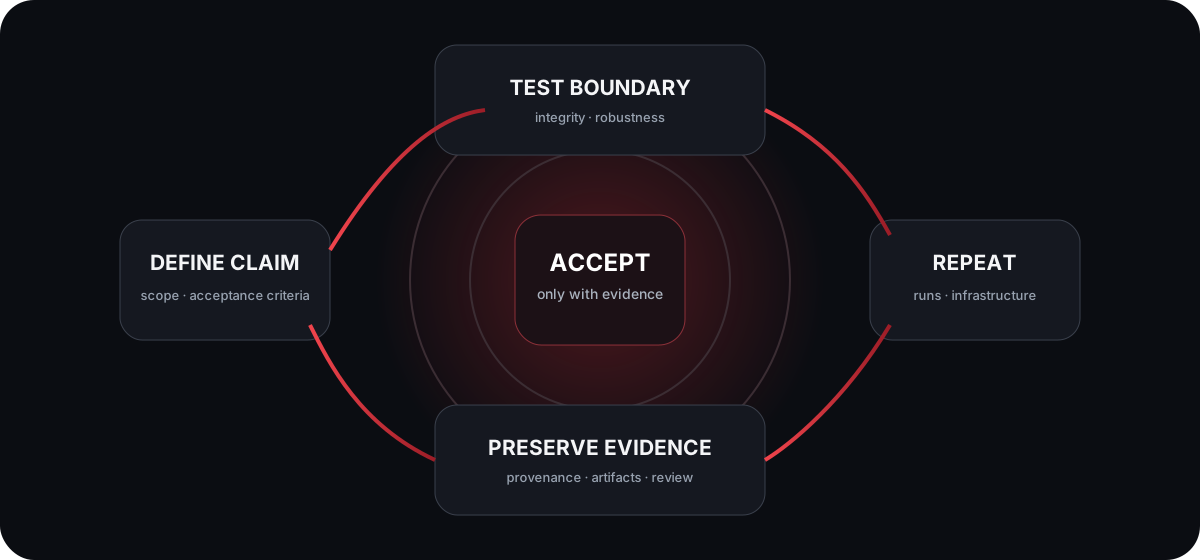
Runtime assurance starts with a bounded claim, explicit acceptance criteria and an evidence plan. It does not certify intelligence in the abstract.
Does policy, workflow and authority behave as intended under normal operation?
Do equivalent conditions produce stable, explainable behavior and evidence?
What happens under incomplete, contradictory, variant or boundary-seeking inputs?
Can material outputs and decisions be traced through the runtime path?
Does the system fail closed where required, retain evidence and recover without losing lineage?
Can a reviewer identify where people remained responsible for acceptance, override or final disposition?
Test design can combine baseline, repeat, variant, adversarial, provenance, recovery and cross-infrastructure checks depending on the claim.
An engagement can produce a claim contract, execution record, comparison results, exceptions, reviewer disposition and a bounded statement of what the evidence supports.
The assurance layer observes and tests the governance contract. Accountable business, institutional or operational authority remains outside the assurance mechanism.
Changed versions, environments, policies or authority boundaries may require revalidation.
Boundary: bounded governance claims and defined test families.
Limitation: test-method evidence does not guarantee all future system states.
Boundary: only claims that pass their explicit acceptance criteria may carry the validated label.
Limitation: validation is version/scope/environment specific.
Passing an assurance contract does not prove universal safety, automatic regulatory compliance or certification.
Relevant evaluators include enterprise AI governance and risk owners, regulated institutions, platform operators, sovereign AI programmes and technical due-diligence partners.
Begin with the authority boundary and evidence gap. Each later stage needs a separately accepted scope and measurable evidence gate.